Concrete bags, yield and ready-mix order quantities
Before buying concrete bags, check how much mixed concrete each bag makes. The printed 40 lb or 80 lb weight describes dry material. I use the finished yield on the exact product to calculate the bag count: different mixes can have the same package weight but produce different volumes.
Published bag yields at a glance
These four presets use the approximate finished yields in the QUIKRETE Concrete Mix 1101 data sheet. For a 50 lb bag, 27 / 0.375 = 72 bags per cubic yard before allowance. Your own product label takes priority; enter a different finished yield in the custom field.
| Bag size | Finished yield | Bags for 1 yd³, no allowance |
|---|---|---|
| 40 lb | 0.30 ft³ | 90 |
| 50 lb | 0.375 ft³ | 72 |
| 60 lb | 0.45 ft³ | 60 |
| 80 lb | 0.60 ft³ | 45 |
Start with the finished yield, not the package mass
The QUIKRETE Concrete Mix 1101 sheet gives approximately 0.30 ft³ for a 40 lb bag, 0.45 ft³ for a 60 lb bag and 0.60 ft³ for an 80 lb bag. These values are the preset examples in the calculator. They are not a promise for another manufacturer, lightweight mix, mortar or cement-only bag.
An 80 lb cement bag is especially easy to confuse with an 80 lb premixed concrete bag. Cement is one ingredient; premixed concrete includes its aggregate blend. A cement-only product needs a specified mix design and cannot use the premixed yield shortcut. I keep the exact product name and stated yield beside the estimate rather than referring only to the bag weight.
Calculate a bag count from the measured volume
The basic calculation is whole bags = round upward(required volume / yield per bag). Convert both volumes to the same unit first. For 27 ft³, which is one cubic yard, the example 80 lb yield gives 27/0.60 = 45 bags without allowance. A 60 lb yield gives 27/0.45 = 60 bags; a 40 lb yield gives 27/0.30 = 90 bags.
Those figures are three alternative ways to fill the same space. Choose the quantity for your intended product. Combining different products or using partial bags requires the appropriate mixing instructions; a bag count alone tells you nothing about the strength of that mixture.
A result just above a whole bag rounds up. With a required 0.61 ft³ and a 0.60 ft³ yield, the quotient is approximately 1.0167, so two bags are needed. Rounding to the nearest integer would return one and leave the estimated space short. Floating-point noise at an exact integer boundary is handled separately from a real measured excess.
Separate allowance from the supplier increment
Allowance adds a percentage to geometric net volume. A supplier increment rounds the resulting required volume to an available order multiple. These are independent adjustments with different purposes. I record both instead of writing one unexplained extra percentage beside the final number.
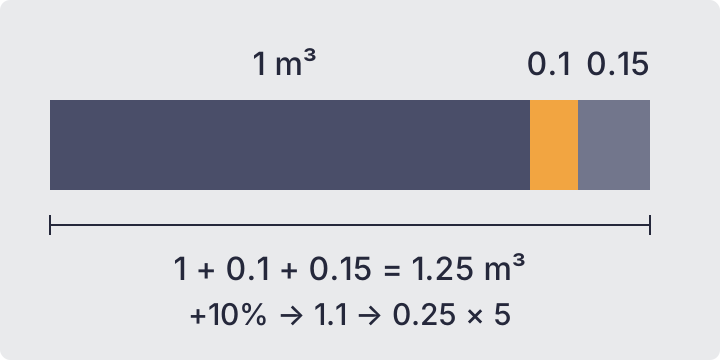
For a net 1 m³ example with 10% allowance, required volume is 1.1 m³. A supplier selling in 0.25 m³ increments would round that to 1.25 m³. The allowance is 0.1 m³; rounding contributes 0.15 m³ more. The diagram in the concrete calculator shows those quantities separately.
Bag counts use the required volume with allowance, not the rounded ready-mix order. An increment offered by a truck supplier does not govern the package yield of a bag. If the calculator rounded the volume first and then counted bags, it could add an unnecessary second purchasing rule to the bag estimate. Set the supplier increment to zero when you do not need that ready-mix comparison.
Follow the metric slab through both supply choices
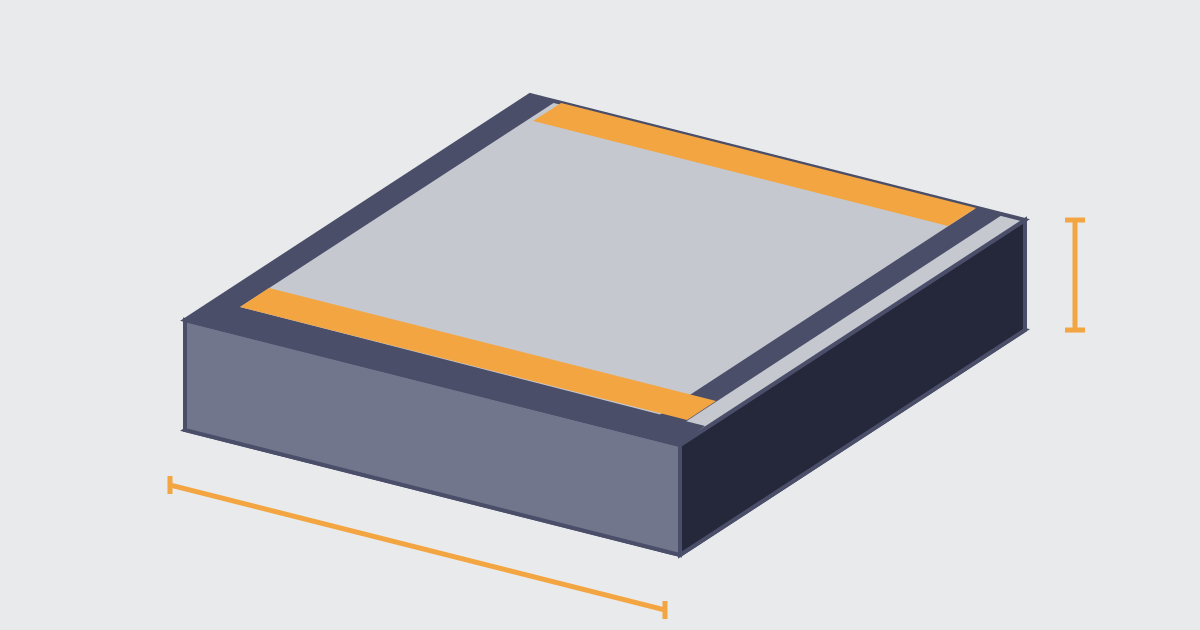
Take a slab 3.6 m by 2.4 m and 0.1 m thick. Area is 8.64 m² and net volume is 0.864 m³. A hypothetical 10% allowance adds 0.0864 m³, giving 0.9504 m³ required. The exact cubic-foot conversion is 0.028316846592 m³, so a 0.60 ft³ example yield corresponds to 0.0169901079552 m³.
Dividing 0.9504 by that yield gives approximately 55.9384. Round upward to 56 bags. Multiplying 56 by 0.0169901079552 gives approximately 0.9514460455 m³ of nominal finished yield. That is only slightly above the requirement; product yield and actual site measurements remain approximate in practice.
For a ready-mix comparison with 0.25 m³ increments, round 0.9504 up to 1 m³. This is a different supply route, not an instruction to order the truck plus the bags. Ask the supplier about actual charging increments, minimum load, access and placement arrangements before using a theoretical material total as a purchase quantity.
Compare costs without inventing a delivered price
The optional material-price field multiplies the rounded ready-mix quantity by your entered price per m³ or yd³. It does not find a local price. If the hypothetical price is 150 currency units per m³ for the slab example, the rounded 1 m³ order has material estimate 150.00.
The breakdown is 0.864*150 = 129.60 for net concrete, 0.0864*150 = 12.96 for allowance and 0.0496*150 = 7.44 for supplier rounding. The three figures total 150.00. This separation helps explain why the geometric quantity and the priced quantity differ without labelling the entire uplift as waste.
Delivery, tax, pump hire, labour, short-load charges and minimum-order fees are excluded. A bag-versus-ready-mix price decision needs those costs, mixing capacity and placement logistics outside this tool. I compare the complete quote before choosing a supply route; a lower raw material total can be offset by delivery or mixing costs.
Choose assumptions you can explain
The default 10% allowance is editable, not an established requirement for every pour. Measure the formed or excavated space carefully first. A deep spot in the subgrade is additional geometric volume; adding a percentage after using the wrong thickness can still underestimate it. Actual losses and supplier rules are separate judgments.
The density field begins at a declared 2400 kg/m³ assumption. Net and order weights use that one density, with pounds converted from kilograms consistently. Dry bag mass and finished concrete weight are not interchangeable, especially after water is added. An estimate does not determine whether your vehicle can safely transport the material.
The manufacturer’s bag calculator explains that its approximate yields do not include uneven substrate or waste. Read the product instructions for mixing and placement instead of adjusting water to force an assumed volume. The calculator does not choose a structural thickness, concrete strength, reinforcement or curing method.
Keep a reproducible quantity note
I keep the steps below with an estimate so another measurement can be compared fairly. In a multi-part job, label the components and save them explicitly. Changing a draft does not change a saved row, while allowance, density, order increment and other global settings still apply to the job total.
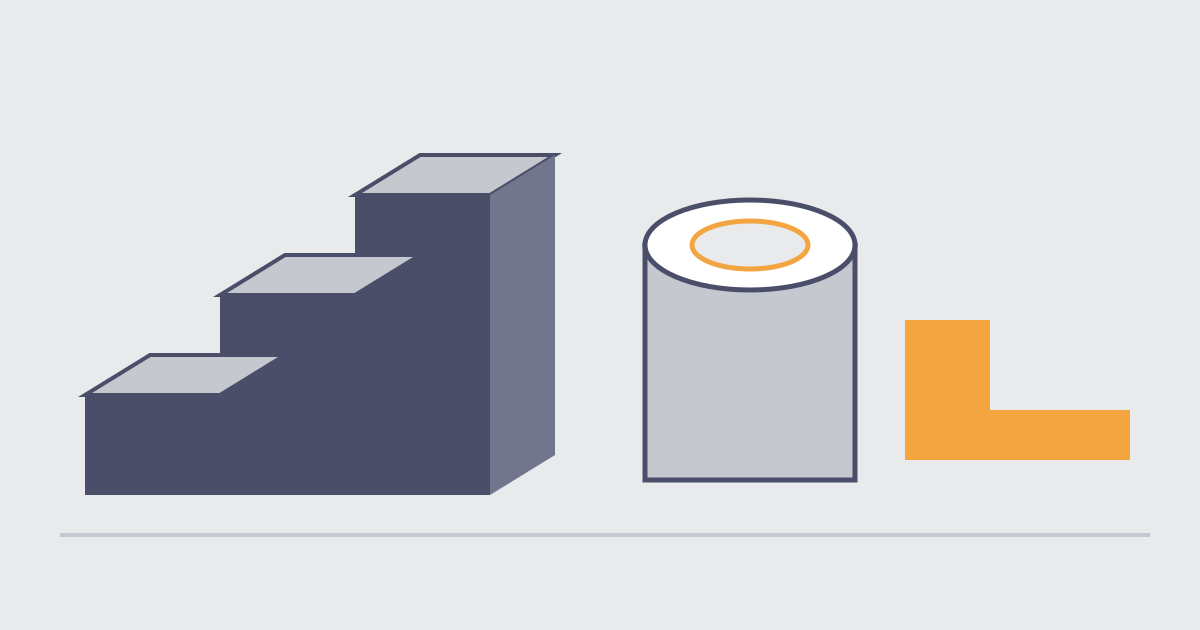
Copy the report or export CSV before closing the tab if you need a quantity record. History saves drafts and their settings only after you choose Save; device storage is a separate option. For solid stair, hollow tube and curb measurements that commonly produce the wrong input volume, read Measuring solid stairs, tubes and curb sections.
- Identify the actual product or solid and its measurement convention.
- Convert all dimensions and yield values into consistent units.
- Calculate the net volume and check repetitions.
- Add the chosen allowance explicitly.
- Apply the appropriate whole-bag ceiling or supplier order increment separately.
| Example | Net m³ | What changes the order |
|---|---|---|
| Metric slab | 0.864 | 10% example allowance → 0.9504 required |
| Four solid steps, no platform | 0.5712 | Rear platform 0.5 m adds 0.408 |
| Tube D 0.6 / d 0.3 / H 1 | 0.2120575041 | Changing the inner diameter changes the void |
If the base is uneven or the slab has deeper edges, read Concrete slab thickness and thickened edges to calculate that additional geometric volume before choosing an allowance.
Questions and answers
How many 80 lb bags make one cubic yard?
At the stated example yield of 0.60 ft³ per bag, 27 / 0.60 = 45 bags before allowance. Verify your actual product yield.
Can I estimate bags from dry package weight alone?
No. Use the finished yield stated for the particular mix. Cement-only bags, premixed concrete and lightweight products are different products.
Why do bags use a different volume from the rounded truck order?
Bags cover the volume with allowance and round to whole packages. Ready-mix independently rounds that volume to the supplier’s order increment.
Does the material estimate include a minimum-load fee?
No. Delivery, tax, pump, labour and minimum-order or short-load charges must be checked separately with the supplier.