Concrete slab thickness and thickened edges
One centimetre of extra thickness over a 4.8 m by 3.2 m slab adds 0.1536 m³ of concrete. That is a measurement difference before any allowance or supplier rounding. I check depth across the whole formed area rather than relying on the shallowest corner or assuming that a nominal thickness describes an uneven base.
Measure the space inside the forms
For a rectangular slab, net volume is length × width × thickness. Length and width describe the finished inside area to be filled. Thickness is the distance from the prepared base to the intended finished surface, not the height of a form board sitting partly below that surface. Keep all three dimensions attached to their units.
A slab measuring 4.8 m by 3.2 m has area 4.8 × 3.2 = 15.36 m². At an illustrative 0.12 m thickness, volume is 15.36 × 0.12 = 1.8432 m³. Enter these measurements in the concrete calculator with quantity one. The diagram and converted-dimensions panel let you check that 12 cm became 0.12 m rather than 12 m.
Use the thickness specified for your project. The example demonstrates volume arithmetic; thickness, reinforcement and concrete strength come from the project design. I then measure the space to be filled, including any variation in depth.
Compare thickness without changing the design
The slab comparison shows the same length, width and quantity at one centimetre less and one centimetre more thickness. For the example area, each centimetre contributes 15.36 × 0.01 = 0.1536 m³. At 11 cm the net volume is 1.6896 m³; at 12 cm it is 1.8432 m³; at 13 cm it is 1.9968 m³. These outputs exclude allowance.
I use this comparison to understand the effect of a measurement error or a measured change in the base. It is not a way to justify ordering less concrete by reducing a specified thickness. If the formed depth actually differs from the intended design, resolve that difference before turning the estimate into an order.
| Measured thickness | Area | Net volume |
|---|---|---|
| 0.11 m | 15.36 m² | 1.6896 m³ |
| 0.12 m | 15.36 m² | 1.8432 m³ |
| 0.13 m | 15.36 m² | 1.9968 m³ |
Split uneven depth into measured regions
Suppose the same slab has two equal-width strips: each is 4.8 m long and 1.6 m wide. One measured strip is 0.11 m deep and the other is 0.15 m deep. Their volumes are 4.8 × 1.6 × 0.11 = 0.8448 m³ and 4.8 × 1.6 × 0.15 = 1.152 m³. Added together, they require 1.9968 m³ before allowance.
Because the two areas are equal, an average depth of (0.11 + 0.15) / 2 = 0.13 m gives the same total. When the areas differ, use an area-weighted average or save separate slab components. A simple average of a few depth readings is not automatically representative of the whole excavation.
For a genuinely linear depth change from 0.10 m to 0.16 m across a rectangular region, the mean depth is 0.13 m. That shortcut assumes a linear profile. Pockets, irregular edges and abrupt changes need additional measurements. Do not call an extra measured volume waste: it is concrete occupying real space.
Add only the extra depth of thickened edges
A thickened edge usually includes some concrete already counted in the main slab. Adding its entire depth again double counts that overlap. I first calculate the full slab at its base thickness, then add edge strips using only the depth below that already-counted slab.
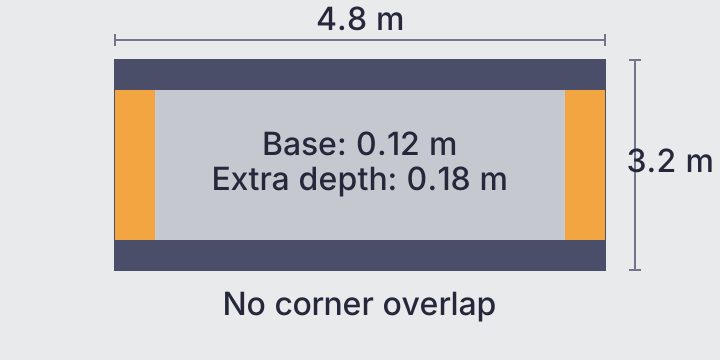
Take the 4.8 m by 3.2 m slab at 0.12 m, with illustrative edge strips 0.25 m wide and 0.30 m total depth. Extra edge depth is 0.30 − 0.12 = 0.18 m. Two full-length strips have combined plan area 2 × 4.8 × 0.25 = 2.4 m². The two remaining end strips fit between them, so their length is 3.2 − 2 × 0.25 = 2.7 m and their combined area is 2 × 2.7 × 0.25 = 1.35 m².
Total edge area is 2.4 + 1.35 = 3.75 m². Extra concrete is 3.75 × 0.18 = 0.675 m³. Add the base slab: 1.8432 + 0.675 = 2.5182 m³. Shortening the end strips prevents the four corners from being counted twice. This is a rectangular volume example, not a foundation specification.
Keep a labelled total you can reproduce
Add the base slab as one component. Add each pair of identical edge strips with quantity two: long strips are 4.8 × 0.25 × 0.18 m, and short strips are 2.7 × 0.25 × 0.18 m. Label them so a later reader can distinguish base thickness from additional edge depth. Once the saved list contains components, totals use that list rather than an edited draft.
- Record the inside length, width and measured depth.
- Separate regions with different depths or cross-sections.
- Exclude the slab overlap from any extra edge depth.
- Exclude corner overlap from intersecting edge strips.
- Check the saved component total before adding allowance.
For the 2.5182 m³ example, a hypothetical 7.5% allowance adds 0.188865 m³ and gives 2.707065 m³ required. A supplier increment of 0.2 m³ then rounds the order to 2.8 m³, adding 0.092935 m³ separately. Confirm both choices with the supplier; neither is a universal rule. The report records the active volumes and the component dimensions, while CSV provides a volume breakdown.
Compare bag yield and truck increments in Concrete bags, yield and ready-mix order quantities. For nonrectangular components, read Measuring solid stairs, hollow tubes and curb sections. A useful quantity note records assumptions as clearly as its final number.
Questions and answers
Can I add the full edge depth to my slab volume?
Only if that volume does not overlap the base slab. For edges beneath the slab, add the extra depth below the thickness already counted.
Can I average two different slab depths?
Yes when the represented areas are equal, or when using an appropriate area-weighted average. Irregular depths require more measurements.
Does the thickness comparison recommend a safe thickness?
No. It shows quantity differences for measured scenarios; structural thickness and reinforcement require the applicable project design.